
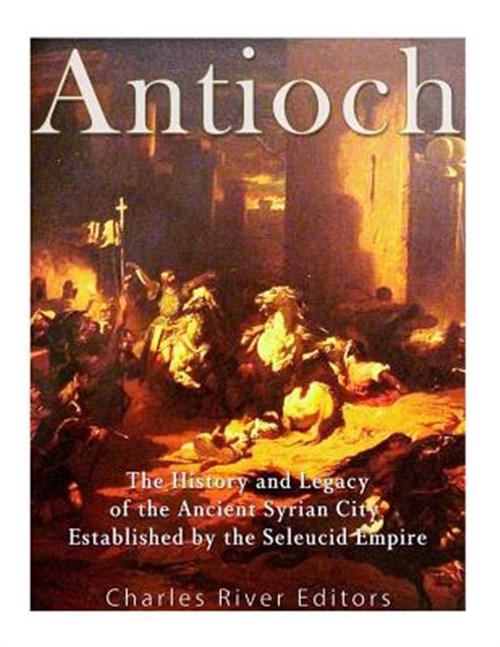
Antioch: The History and Legacy of the Ancient Syrian City Established by the Seleucid Empire (Paperback) by Charles River
Product details
| Management number | 240391387 | Release Date | 2026/07/16 | List Price | US$5.91 | Model Number | 240391387 | ||
|---|---|---|---|---|---|---|---|---|---|
| Category | |||||||||
9781548485580. New condition. Trade paperback. Language: English. Pages: 82. Trade paperback (US). Glued binding. 82 p. *Includes pictures <br> *Includes ancient accounts <br> *Includes online resources and a bibliography for further reading <br> On his deathbed, some historians claim that when he was pressed to name a successor, Alexander the Great muttered that his empire should go "to the strongest". Other sources claim that he passed his signet ring to his general Perdiccas, thereby naming him successor, but whatever his choices were or may have been, they were ignored. Alexander's generals, all of them with the loyalty of their own corps at their backs, would tear each other apart in a vicious internal struggle that lasted almost half a century before four factions emerged victorious: Macedonia, the Seleucid Empire in the east, the Kingdom of Pergamon in Asia Minor, and the Ptolemaic dynasty in Egypt. During the course of these wars, Alexander's only heir, the posthumously born Alexander IV, was murdered, extinguishing his bloodline for ever. <br> Despite the infighting among them, one thing Alexander's generals did agree upon was their Hellenistic culture. Most famously, Ptolemy's line firmly established the Hellenistic culture of the Greeks while ruling over Egypt, and by marrying within their family line, the Ptolemaic pharaohs kept their Hellenistic heritage until the very end of Ptolemy's line, which died with Cleopatra in 30 BCE. Although the Seleucid Empire is less well known, Alexander's general Seleucus was no less successful in "Hellenizing" Persia and parts of Asia Minor. The Greek influence is still readily visible in the region thousands of years later. Anthropologists have found that some of the earliest Buddha statues constructed in India bear an uncanny resemblance to Ancient Greek depictions of Apollo, and local legend has it that the wild olive trees that grow in some regions of Afghanistan sprang from the olive seeds that Macedonian soldiers spat out on the march - not to mention the presence of Balkan features such as red hair and blue eyes among a significant amount of the locals there to this day. Legends of Alexander crop up amid the popular mythology of half the world, and while some among the Persian Empire called him "the accursed", it is now widely believed that the story of the prophet Dhul-Qarnayn ("The Two-Horned One") in the Qur'an is a reference to Alexander. <br> For a time, the Seleucids commanded the largest empire in the world as it stretched from the high plains and deserts of what is now Afghanistan in the east to parts of the Levant and Asia Minor in the west. The empire's early kings were strong and shrewd and committed to the ideas of Hellenism as much as holding power and expanding the realm of their empire, but later rulers did not prove as capable. In time, the Seleucid royal house often descended into orgies of violence which were driven by ambitious men and women. <br> Antioch served as the most important city of the Seleucid kingdom from the 3rd century BCE onwards, and by the 1st century CE Antioch had grown into a well-fortified and cosmopolitan Roman city, famous throughout the Roman Empire alongside its neighboring town of Daphne. This rich, beautiful city was the setting of the major gods, goddesses, myths, and legends of the Classical world; a city beloved by divine and mortal, pagan and Christian alike. This was approximately the same time that the Christian Church was founded in Antioch by those fleeing Jerusalem after the martyrdom of Saint Stephen, and it was from this city that Saint Paul left on his missionary journeys. <br> Antioch continued to serve as an iconic Christian city during the Crusades. It was one of the first cities to be captured by the European armies of the First Crusade, and from that point forward, two powerful dynasties - the house of Hauteville and the house of Poitiers - ruled from there over the principality of Antioch.
Antioch: The History and Legacy of the Ancient Syrian City Established by the Seleucid Empire (Paperback)| Book format | Paperback |
|---|---|
| Fiction/nonfiction | Non-Fiction |
| Genre | History |
| Publication date | July, 2017 |
| Pages | 82 |
| Subgenre | History |
| Publisher | Createspace Independent Publishing Platform |
| Original languages | English |
| Language | English |
| Binding type | Perfect Binding |
| Assembled product dimensions (l x w x h) | 8.50 x 0.17 x 11.00 in |
| Assembled product weight | 0.47 lbs |
| Bisac subject heading | History |
Correction of product information
If you notice any omissions or errors in the product information on this page, please use the correction request form below.
Correction Request Form